We have demonstrated the scientific feasibility of our approach in Phase I with a full kinematics chain analysis (see Volume 5) and with the assembly of a functioning prototype as described above; absent this prototype, the merits of the technology should hopefully be clear from its simple combination of prior art mechanisms.
During the course of Phase I, we discovered many simplifications that were left unimplemented – the most important of which is demonstrated in Figure 7. The existing design in Figure 2 has a total height of 6”, under the premise that the fan is spun by a motor- or engine-driven pulley. This height is due to separation between the scotch yoke and the lead screw’s nut/reluctance rotor combination – the latter of which is approximately 3” in height and which travels 0.185” for blade articulation. The reluctance rotor mounted on the nut also creates tolerancing stackup challenges which are surmountable but undesirable. The original design is reliant on radial flux because the motor’s rotor travels axially with the nut. All of these issues are resolved in the new design shown in Figure 7 where the pitch-manipulating motor is fixed axially while left rotatable within the rotor system. The motor is affixed to a yoke which has sliders extending upward (in fact, in the form of shoulder bolts). The sliders are received by linear bearings in the scotch yoke which has a lead screw thread on an interior diameter that mates to the fan’s threaded shaft. The scotch yoke travels axially when the pitch-control rotor is spun as before. The pitch control motor can now be formed from any standard motor topology since it no longer travels axially.
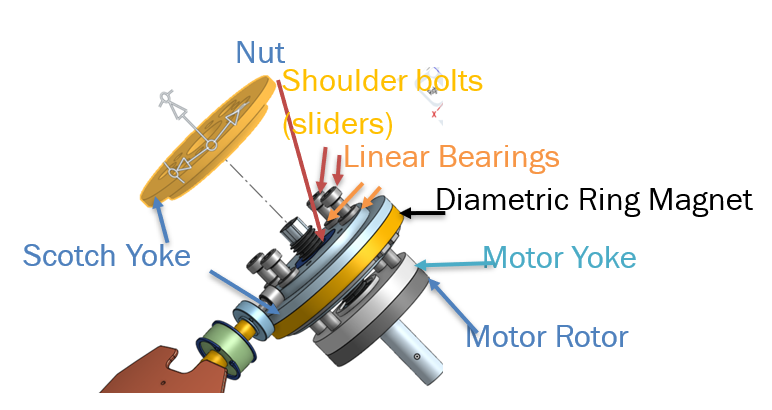
Figure 7 New EMCP slider approach
The most ideal topology would be a synchronous axial reluctance motor – which can be achieved with incipient market solutions using soft magnetic composites (SMC). The use of a reluctance motor avoids the regenerative effect from having permanent magnets spinning near electromagnet coils that could otherwise be inactive when pitch actuation is fixed and inactive. This approach has not yet been fully proven in a prototype but all its components are freely available on the market. It is therefore low risk with an analogous prototype already under construction.
In Phase II we will create a completed mechanical/electric design for use in silent-watch applications that has both a pitch- and spin-control motor. A second axial reluctance motor would be ideal for spin control as we continue down the path omitting permanent magnets (especially rare-earth ones). The new slider design is a simplification over our first design so the majority of Phase II will be focused on the motor designs as well as maturing electronics and software solutions. To mitigate risk and ensure success, we are partnering with Yeadon Energy Systems Inc. located in Michigan. They will mature our laminated axial reluctance motor design given their 30 years of experience in the field.
We will build an inverter board for the pitch-control motor that can mount as a daughter board on the USG’s Zeus inverter which we are presently in negotiations to license. We will license the 10kW and 50kW variants of the Zeus inverter for fan spin control. We may outsource the electronic’s design of the pitch-control motor’s inverter to mitigate risk related to internal expertise – we will then complete the software and control system design ourselves. Geofabrica will again be employed to finalize our mechanical design for manufacturability using their greater expertise in the subject matter. Near the time of submission, Cool Mechatronics is in discussion with Great Lakes Sound and Vibration (GLSV), experts in air flow design, to possibly create a complete mixed flow fan mechanical design for Phase II. We have found partners with expertise to augment our approach and minimize risk while enabling us to focus our own efforts on solutions more core to our controls and systems engineering expertise.
Achieving full MIL-SPEC rating will be challenging, presenting a risk, but doable with the use of a GVSC CRADA and possible Phase III funding; completion of Phase II, should leave us with a commercially viable solution from which revenue can be used to direct towards achieving such certification.
Our design is an increase in complexity over fixed-pitch fans/propellers, the concern of which can be mitigated in the eyes of our customers by pointing to the complexity of that of hydraulics as a comparison other.