Solution’s Advantages and Impact
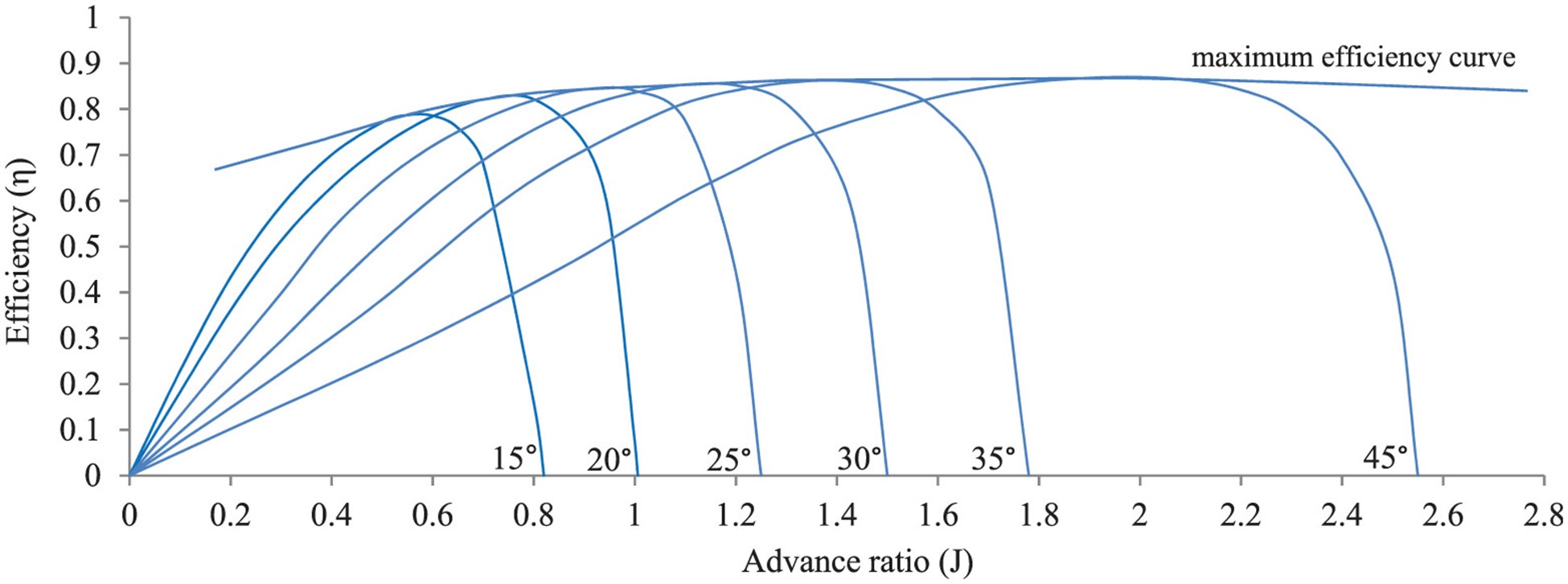
Noise. The case study from ABB2 also noted significant reductions in noise levels because of speed changes alone – as high as 12 dBa. Where the efficiency advantages of adding pitch control over varying speed required analysis of case studies, its advantage for noise is easier to advance. Figure 1 shows the efficiency curves for a propeller operated at different pitch for a given blade angle as a function of advance ratio (effectively speed). For any given pitch, efficiency drops off quickly when operated away from the pitch’s ideal operating speed. One of the predominant such losses is through noise. The Wärtisilä study3 also demonstrated significant noise reductions and elimination of vibration on the ship’s hull as a result of better pitch control which eliminated cavitation.
This is a significant consideration for a military vehicle in addition to the benefits for continuous thermal signature management.